HELSTON
The bustling market town of Helston lies midway between Falmouth and Penzance at the junction of the A394 and A3083, which serves the Lizard Peninsula to the south. Ideally located for exploring South West Cornwall, Helston has plenty for visitors of all ages.
Helston on Cornwall' Lizard Peninsula is most famous for the 'Furry' or Floral Dance. The Helston Floral Dance is an annual carnival held on the 8th May, (but if it falls on a Sunday or Monday the event is held on the preceding Saturday).
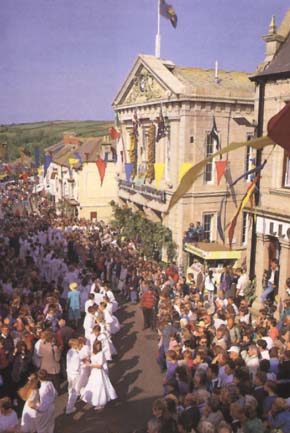
On the Flora Day, Helston's streets are lined with thousands of visitors, The canrnival runs through the whole day and into the night. During the days festivities At 7.00am and again at 8.30am there is the Hal-an-Tow, in which St George and St Michael slay the Dragon and the Devil, cheered on by a crowd in Elizabethan dress. The children’s dance is at 10.00am. At midday is the main dance, with participants dressed in top hats, tails and ball gowns. The final dance is at 5.00pm. Throughout the day, dancers weave in and out of shops, houses and gardens following the Helston Town Band playing the famous Floral Dance.
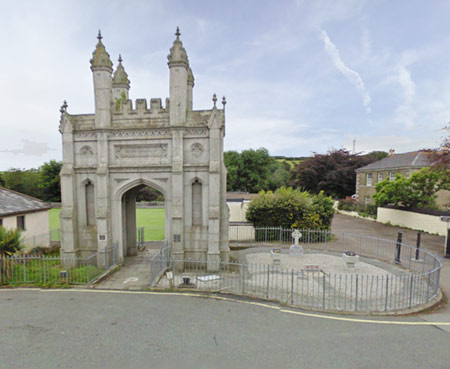
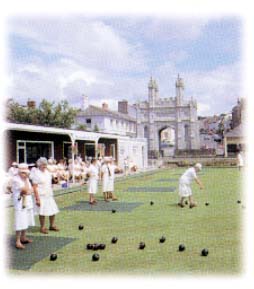
As you explore Helston, you'll see a mixture of Georgian and Victorian architecture, one outstanding feature being The Monument at the end of Coinagehall Street, built in 1834 to the memory of Humphry Millet Grylls. A Helston banker and solicitor, his actions kept open the local tin mine, Wheal Vor, and saved 1200 jobs.
Walking up Coinagehall Street, you'll pass the Blue Anchor, a thatched building, originally a monks' rest house, which became a tavern in the 15th century.
Miners received their wages in the pub, which is possibly the oldest private brewery in the country (beware the local brew, Spingo!).
Further up, you'll find one of the oldest buildings in Helston, the Angel Hotel, the former town house of the celebrated Godolphins who represented Helston in Parliament for many years.
One Wendron Street cottage marks the birthplace of Bob Fitzsimmons. Born 1863, he was the first man to be world middleweight, light heavyweight and heavyweight boxing champion. He retired in 1914 and died in Chicago three years later.
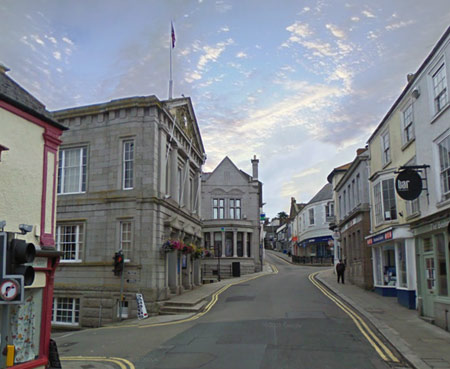
By the traffic lights is the imposing Guildhall. Over the years this has been a market house and Magistrates' Court; today it is the Town Hall with the Council Chamber on the first floor.
The ground floor is still called the Corn Exchange and here you might be tempted inside by coffee mornings, craft markets andjumble sales.
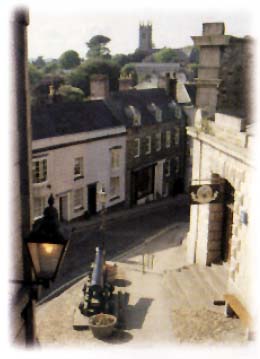
Behind the Guildhall you'll see a splendid cannon taken from HMS Anson, wrecked at Lee Bar in 1807. This event, with its loss of life, inspired Henry Trengrouse to invent the Breeches Buoy.
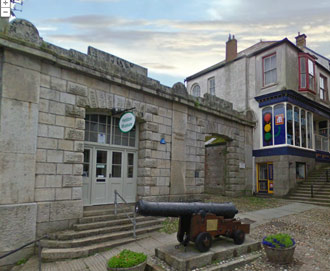
The cannon stands on guard outside the Helston Folk Museum, housed in the old butter market, where you'll be fascinated by the exhibitions of Helston's heritage - and admission is free!
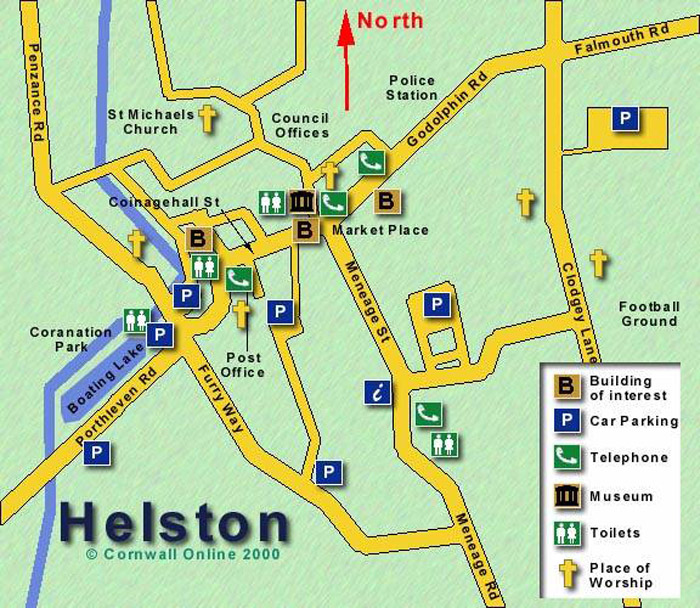
Continuing along Church Street, you'll arrive at the parish church of St Michael, dedicated to the patron saint of Helston. It contains an impressive 24-branch chandelier - a gift from the Earl of Godolphin in 1763 - and some fine Elizabethan brasses.
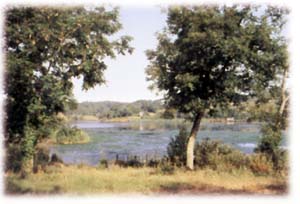
As you head out of Helston, past the Coronation Park & Boating Lake, towards the fishing village of Porthleven, you'll come to the parkland of the Penrose Estate, which offers some beautiful woodland walks. Here you can relax on the banks of the largest freshwater lake in Cornwall, Loe Pool, separated from the sea by a long sand bar.
Helston's formative years have been lost in the mists of the Dark Ages. However, it was certainly in existence in the sixth century when it was inhabited by Saxons. Its, name derives from hen lis - the Cornish word for "old court", to which was added ton, denoting that it was a Saxon manor.
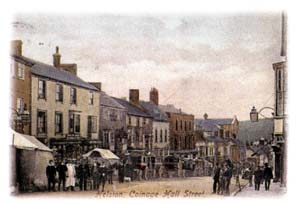
In the Domesday Book, Helston is, referred to as Henliston and King John granted its charter in 1201. Helston thus became a free borough town having certain privileges, the right to its own court being the most important. In these years Helston had a castle once the residence of Edmund, Earl of Cornwall - which was sited at the bottom of Coinagehall Street.
The town stands on the east bank of the River Cober which was once tidal, before it was cut off from the sea by Loe Bar in the 13th century. According to some sources, Helston, with a population then of about 200, was a small port which exported tin and copper.
Helston has always been closely associated with mining - indeed the river was once a very rich tin stream. The town became a coinage town during thr reign of Edward I and more than 100 tin and copper mines, have been worked in the district over a long period of time. The word coinage comes front the French coin, meaning corner; the quality and value of tin was assessed by cutting off a corner from a block for testing. It was theni stamped, taxed and eventually sold. Local miners would assemble to have their tin tested and weighed in the 'coinage hall', hence the name of Helston's main thorough fare, Coinagehall Street.
Helston Cornwall
Helston FLORA DAY
Helston Furry, or Flora Dance
Perhaps Helston's greatest claim to fame is the internationally famous festival of the Furry, or Flora Dance. This is held every year on May 8th unless that day falls on a Sunday or Monday, when it is held on the preceding Saturday.
You'll probably have to park outside the town and walk in. Thousands of visitors throng the streets all day and there's a carnival atmosphere from dawn to well into the night.
You'll find the town decked out with bluebells, gorse, laurel leaves and colourful flags.
Dancing begins at 7.00 am, and at 8.30 there's the mummers'play known as the Hal-an-Tow, at several venues throughout the town.
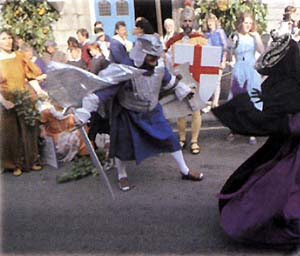
Watch St George and St Michael slay the Dragon and the Devil, cheered on by a crowd dressed in Lincoln green and Elizabethan robes.
The children of the town dance at 10.00 am, at midday there's the principal dance, with invited participants in top hats, tails and dress gowns; and a final dance at 5.00 pm. The dancers weave in and out of the shops, houses and gardens behind the Helston Band playing the famous Flora Dance tune.
The origins of the dance are certainly pre-Christian and are connected with ancient spring festivals all over Europe. Nowadays its ancient intention of ushering in prosperous harvests goes hand in hand with the splash of colour all over the town, the joyous music and high spirits of all involved.
Helston Holiday Accommodation - Where to stay and Holidays in Helston and the Lizard Peninsula
- Self-catering Holidays in Heslton
- Helston Holiday Cottages
- Campsites and touring parks
-
B&B
in Helston
Hotels in Helston - Holidays in Helston
Helston
Cornwall